
A-brands, competitive prices
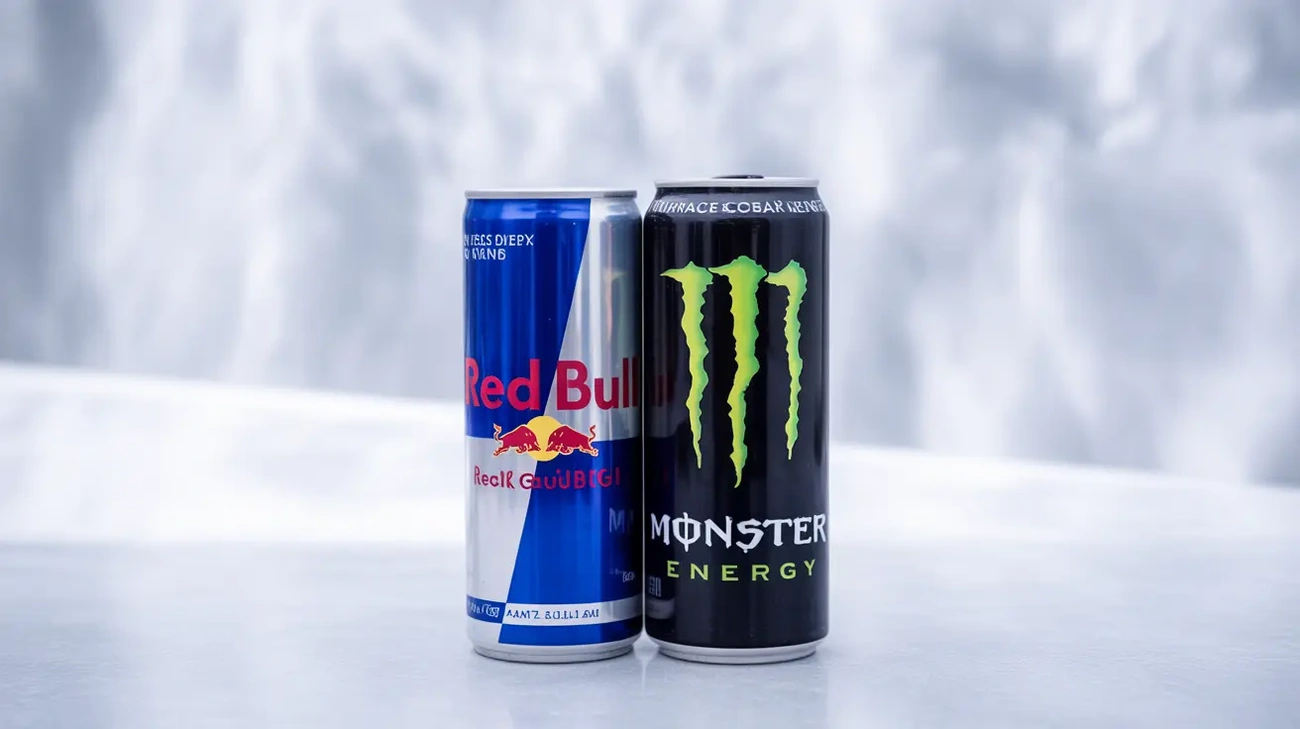
Which Energy Drink Wins in 2026?
Monster vs Red Bull
Monster and Red Bull are the two biggest names in the energy drink market. Both brands dominate the shelves, but they differ on crucial points that shape your purchasing decision.
For instance, a can of Red Bull contains 80 milligrams of caffeine, while Monster offers 160 milligrams. That difference lies not in the concentration, but in the size. Monster supplies 500 ml cans as standard, whereas Red Bull opts for 250 ml or 355 ml. For hospitality operators and retailers, this distinction is felt directly in margin and customer preference.
The range of flavours also varies considerably. Monster offers more than 40 varieties, while Red Bull has 9. So with Monster you have more choice to surprise your target audience, whereas Red Bull focuses on a tight, streamlined range.
This comparison maps out the key differences between Monster and Red Bull, from caffeine content and flavour range to packaging size and business advantages. That way you can decide for yourself which brand best suits your customers and your sales strategy.
WHAT IS MONSTER VS RED BULL?
Red Bull is the founder of the energy drink market. Dietrich Mateschitz launched the brand on 1 April 1987 in Austria, thereby creating an entirely new product category. After three years spent working on the recipe, the brand positioning and the packaging, Red Bull grew into a global leader. The Austrian brand is now sold in 178 countries, has 21,924 employees worldwide and achieved a turnover of 12.196 billion euros in 2025, with 13.969 billion cans sold.
Monster Energy entered the market 15 years later. Hansen Natural Company, now known as Monster Beverage Corporation, launched the brand in April 2002 with a deliberately different positioning. Where Red Bull opted for a broad audience and a premium image, Monster targeted a younger, rebellious segment. That paid off. In a relatively short time, Monster captured a market share of 30.1% in the United States.
Together, both brands control more than 80% of the global energy drink market. Red Bull holds 43%, Monster 39%. This means that, as a retailer or hospitality operator, you almost always deal with one of these two brands. Red Bull positions itself as a premium product with smaller portions, Monster as a volume player with larger cans at a comparable price. Which brand best suits your customers depends on your target audience and sales strategy.
WHY MONSTER AND RED BULL REMAIN POPULAR IN 2026
The energy drink market grows by 7.5% annually and is expected to reach 128.7 billion dollars by 2033. That makes Monster and Red Bull not only popular brands, but also a strategic choice for every retailer. Red Bull sold no fewer than 13.969 billion cans in 2025, an increase of 10.2%, and retains a 35% market share in the United States with brand awareness of 92%. Monster shows even stronger growth figures, with turnover growth of 26.9% to €1.91 billion in the first quarter of 2026.
International expansion drives this growth further. Monster's turnover outside the United States rose 44.9% to €0.95 billion, accounting for 45% of total sales. The figures are impressive closer to home too. Monster grew by 180% in the Netherlands to 65 million euros, making it the fastest riser among all supermarket brands. Red Bull achieved a turnover increase of 12% to 256 million euros in that same market. In this way, both brands demonstrate that the growth is structural, not coincidental.
Consumers are also increasingly asking for sugar-free varieties. A third of Monster's sales now consists of sugar-free options. Both brands actively respond to this by expanding their range with low-sugar formulations. For retailers, this means stable margins alongside growing volumes, as sugar-free varieties generally deliver higher margins. When you respond to this shift, you strengthen not only your offering but also your profitability.
MONSTER VS RED BULL CAFFEINE: THE DIFFERENCE IN COMPOSITION
Both energy drinks contain exactly the same caffeine concentration: 32 mg per 100 ml. Yet the caffeine content per can varies considerably. Red Bull delivers 80 mg of caffeine in 250 ml, Monster offers 160 mg in 500 ml. The size makes the difference, not the formula.
The basic composition is identical for both brands. Alongside caffeine, Monster and Red Bull contain taurine (4.0 g/l), glucuronolactone (2.4 g/l) and B vitamins such as B3, B6 and B12. Taurine supports heart function, while glucuronolactone serves as a small energy source. But the actual energy boost comes entirely from caffeine and glucose.
The sugar content per can also differs. Red Bull contains 27 grams of sugar in 250 ml, Monster around 42 grams in 500 ml. Per 100 ml they barely differ. And what about the sugar-free varieties? Red Bull Sugar Free and Monster Zero Sugar maintain exactly the same caffeine values, but without a single gram of sugar. That way you can make the right choice for every customer profile.
The European Food Safety Authority (EFSA) sets the safe maximum at 400 mg of caffeine per day for healthy adults. This means that one Monster covers 40% of that limit, one Red Bull 20%. For pregnant women and people with heart conditions, a lower limit of 200 mg applies. Useful information to point out to your customers.
HOW RETAILERS USE MONSTER AND RED BULL WISELY
Your choice of range between Monster and Red Bull depends on shelf space, target audience and profit margin. Monster offers the same retail price as Red Bull but contains twice as much product. This makes Monster attractive to price-conscious consumers, while Red Bull positions itself as the premium option with smaller portions. Both have their own place on your shelf, depending on who your customer is.
An interesting example: in 2018, Albert Heijn stopped selling half-litre Monster Energy cans following concerns from parents about sugar consumption among children. Other energy drink brands remained available as normal. There is no statutory age limit for the sale of energy drinks, but as a retailer you can operate your own policy around large sizes. In this way, your own customer group always comes first.
And what about vending machines as an additional sales channel? The global vending market was valued at more than 35 billion euros in 2024, with annual growth of 6.7%. You determine the range and the prices yourself, from healthy snacks to energy drinks. In busy locations such as offices and sports centres, a well-stocked machine pays back the investment within a year.
In 2014, Monster concluded a distribution deal with Coca-Cola, allowing the brand to roll out across growth markets via a global network. In addition, Monster invests heavily in influencer marketing through athletes and musicians, which creates a loyal following. In this way, Monster continually builds brand preference among a young and engaged audience.
VARIANTS, PACKAGING AND FLAVOURS
Red Bull has eleven flavour varieties in 2026, Monster supplies more than 40. For retailers, that is a substantial difference. A broad range attracts more customers, but also requires more shelf space and purchasing planning.
Red Bull builds its offering in a streamlined way. Alongside the classic Original and Original Sugar Free there are five fruit editions such as Tropical, Peach, Apricot, Cherry and Pink Sugar Free, two Ice Editions and seasonal editions such as Fuji Apple & Ginger and Summer Edition Sudachi-Lime. This way you can respond to a wide range of tastes with a limited number of varieties.
Monster structures its offering around clear product lines. The classic Monster Energy Original Green and Zero Sugar form the basis. In addition there is the Ultra line with eight sugar-free flavours such as Ultra White, Strawberry Dreams and Peachy Keen. And what about Juiced Monster with real fruit juices in flavours such as Mango Loco and Pipeline Punch, or the Rehab iced tea varieties? Almost 60% of the Monster range consists of low-sugar or low-calorie varieties, with 15 sugar-free SKUs worldwide. This way you can also serve the growing group of health-conscious consumers.
Packaging sizes determine your purchasing strategy. Red Bull supplies trays of 24 cans of 250 ml for EUR 31.46 for the Original, or 12 cans for EUR 19.99 for the editions. Monster uses a standard tray of 12 cans of 500 ml for EUR 17.99. Bear in mind that seasonal editions sell out quickly. Tropical and Peach Edition are often no longer available within a few months. Red Bull editions appear via supermarkets, petrol stations and online platforms, with some editions available only temporarily. When you buy in time, you take maximum advantage of this limited availability.
COMMON MISTAKES IN PURCHASING AND SELLING
Buying on price alone is the biggest pitfall with energy drinks. Retailers who look solely at the lowest amount run the risk of delivery delays, incorrect orders or even a supplier going under. Quality and reliability simply carry more weight than a few cents' difference per can.
Cash flow is a point of attention, especially for those just starting out. Without discipline, you buy in too much stock of Monster or Red Bull, tying up capital and leaving you unable to respond flexibly. Start with small quantities and test how your customers react. Only increase your stock after proven sales, based on figures rather than on gut feeling. Buying in too much puts your business at risk, just like being left with summer soft drinks out of season.
Margin determines your profit more than turnover does. A product with a 70% margin that rarely sells delivers less result than an item with a 40% margin that is bought daily. Wholesale prices for energy drinks lie between €0.60 and €0.75 per bottle, with margins of €1.05 to €1.60 per product. This leaves you with an attractive margin, but only if you buy in the right volumes.
Stock security and service quality are just as important as the purchase price. Can your supplier react quickly to demand peaks? Do they have enough Monster and Red Bull in stock during warm weather? You can truly count on this sort of thing once it gets busy.
COMPARISON TABLE: MONSTER VS RED BULL
Monster and Red Bull side by side. This way you can see at a glance where the differences lie and what that means for your purchasing decision.
Feature Monster Energy Red Bull
| Can size (standard) | 500 ml (16 ounce) | 250 ml (8.4 ounce) |
| Caffeine per can | 160 mg | 80 mg |
| Caffeine per 100 ml | 32 mg | 32 mg |
| Sugar per can | 42 grams (500 ml) | 27 grams (250 ml) |
| Number of flavours | More than 40 | 11 varieties |
| Sugar-free share | 60% of range (15 SKUs worldwide) | Multiple Sugar Free options |
| Taurine | 4.0 g/l | 4.0 g/l |
| Glucuronolactone | 2.4 g/l | 2.4 g/l |
| Year of launch | 2002 | 1987 |
| Global market share | 39% | 43% |
| US market share | 30.1% (2022) | 35% |
| US brand awareness | Not stated | 92% |
| Cans sold (2025) | Not stated | 13.969 billion |
| Turnover Q1 2026 | €1.91 billion (+26.9%) | Not stated for Q1 |
| Turnover Netherlands | €65 million (+180%) | €256 million (+12%) |
| Retail price per tray | €17.99 (12 x 500ml) | €31.46 (24 x 250ml Original) / €19.99 (12 cans editions) |
| Wholesale price per unit | €0.60 - €0.75 | €0.60 - €0.75 |
| Margin per product | €1.05 - €1.60 | €1.05 - €1.60 |
| Positioning | Volume player, larger cans at a comparable price | Premium product, smaller portions |
| Target audience | Younger, rebellious audience | Broad, premium segment |
| Distribution | Coca-Cola network (since 2014) | Own global network (178 countries) |
| Product lines | Monster Energy Original, Ultra (8 flavours), Juiced Monster, Rehab | Original, Fruit Editions (5 flavours), Ice Editions, Seasonal editions |
| % of safe daily caffeine limit | 40% (160mg of 400mg limit) | 20% (80mg of 400mg limit) |
PRACTICAL CONSIDERATIONS FOR RETAILERS
In addition to the product specifications, there are also practical considerations that shape your choice. Think of shelf space, target audience and availability. This way you can make the best trade-off for each situation.
Aspect Monster Energy Red Bull
| Price-volume ratio | More product for a comparable price | Smaller portions, premium pricing |
| Shelf space | Larger cans, more space needed | More compact cans, more efficient |
| Target audience preference | Price-conscious consumers, young people | Premium segment, broad audience |
| Range complexity | 40+ varieties, more choice | 11 varieties, more streamlined |
| Availability | Not at all retailers (e.g. Albert Heijn stopped the 500ml format in 2018) | Widely available |
CONCLUSION
Monster and Red Bull are both strong choices, but they serve a different purpose. Monster delivers more volume at a comparable price and appeals to a younger, price-conscious audience. Red Bull positions itself as a premium product with a tight range and broad brand awareness. The caffeine concentration is identical, but the size, the breadth of flavours and the market approach differ substantially.
For retailers, the message is clear. Test both brands, look at your sales figures and choose on the basis of margin and customer preference. When you know what your target audience wants, you also know which brand best suits your shelves.
What ultimately determines your success is not only the brand you choose. Stock security and fast delivery are at least as important. You can truly build on us.
At [company] you can always request a free, no-obligation quote for Monster, Red Bull or other energy drinks. That way you can see for yourself what advantage we can offer you. And you are not tied to anything, because that is how flexible we are.