
A-brands, competitive prices
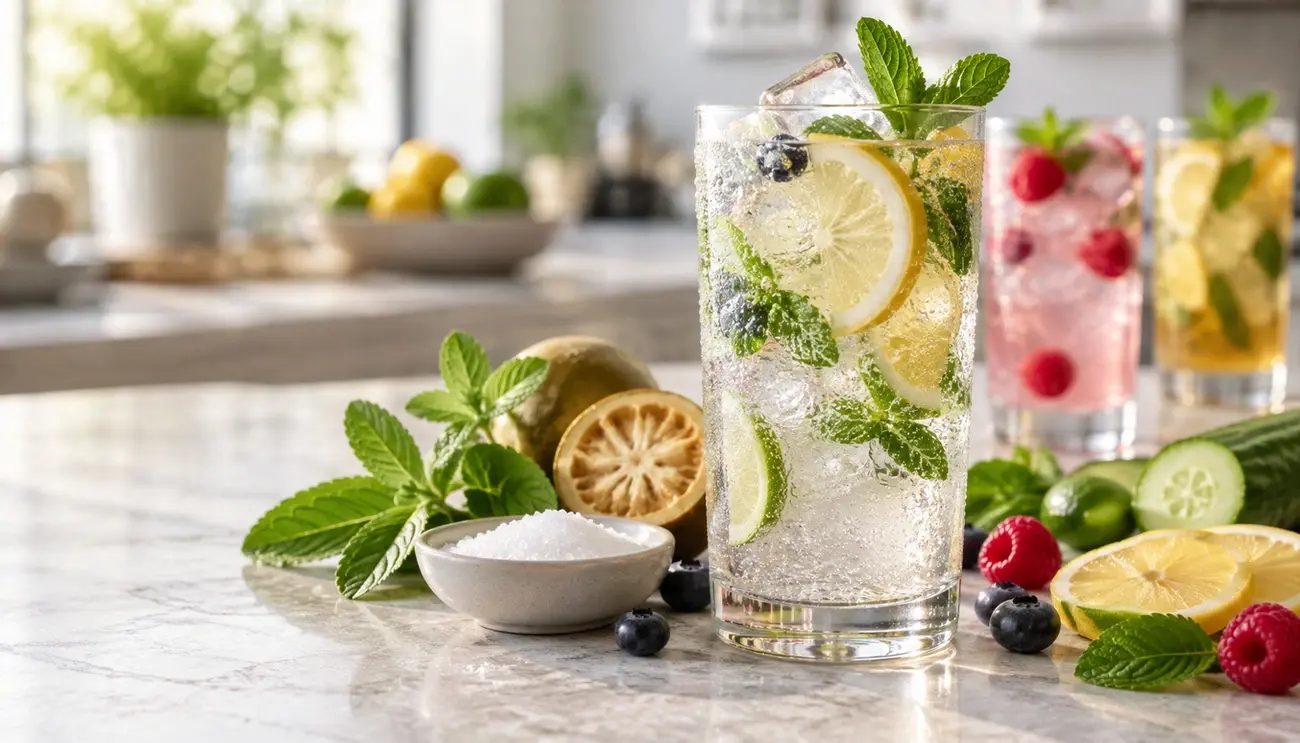
Healthy drinks without artificial additives are gaining ground. In hospitality, retail and vending, the shelves are visibly shifting towards cleaner alternatives. Stevia, up to 300 times sweeter than sugar, shows just how powerful natural sweeteners can be. Consumers are making more conscious choices, and that creates immediate business opportunities for those who respond in good time.
But what exactly are healthy drinks? And how do you recognise a genuinely healthy soft drink among the many clean-label claims currently on the market? Natural sweeteners such as stevia and erythritol enjoy a more positive image than artificial alternatives such as aspartame. Even so, it is the ADI (acceptable daily intake) that determines actual safety, regardless of origin [-4]. Would you like to add healthy alcohol-free drinks to your range? This article gives you the practical insights you need.
WHAT ARE HEALTHY DRINKS WITHOUT ARTIFICIAL ADDITIVES?
Healthy drinks without artificial additives contain no synthetic colourings, flavour enhancers or sweeteners that do not occur naturally. Instead, manufacturers use substances that are also found in plants, fruit or herbs, such as steviol glycosides (E960) from the stevia plant. This distinction determines whether a drink qualifies as 'clean label', which means a product gains a more natural image than comparable products containing synthetic additives.
E-numbers are not automatically unnatural, either. Steviol glycosides are extracted from plant leaves. Aspartame (E951), on the other hand, does not occur in nature and is produced entirely synthetically. You can see this reflected on the label: manufacturers increasingly opt for specific ingredient names such as 'colour: paprika extract' rather than listing only an E-number. As a buyer, this lets you see at a glance what a product really contains.
Concrete examples of pure drinks without artificial additives include:
For hospitality businesses, retailers and wholesalers, this means in practice: when purchasing, look at the full ingredients list, not just the 'natural' claim on the packaging. That way, you can distinguish genuinely healthy soft drinks from products that merely look natural.
WHY DRINKS WITH NATURAL SWEETENERS ARE POPULAR IN 2026
The market is clearly on the move. Dutch sugar policy is reinforcing demand for healthy drinks: the government intends to replace the consumption tax with a levy based on sugar content, making low-sugar drinks cheaper. The average Dutch person consumes 49 grams of free sugars a day, 23 per cent of which comes from soft drinks. Among young people, this figure is even higher. Half of them take in an average of 90 sugar cubes a week through soft drinks.
Consumers themselves endorse this development. 74 per cent of soft drink consumers who are deliberately cutting down on sugar consider sugar-free drinks healthier than the sugary version. This is no minor signal. It is a structural shift in consumer demand.
Major brands are responding. Coca-Cola reports that more than half of its sales in the Netherlands now come from low-calorie and sugar-free drinks. The brand is expanding Fuze Tea No Sugar with flavours such as Green Tea Tropical Passionfruit and has launched Sprite Chill Zero Sugar with mint. Smaller players are also tapping into this demand. Amsterdam-based VYVO is bringing to market a soft drink with neither sugar nor sweeteners, containing natural caffeine from guarana and green tea extract.
And what about the generational divide in sugar consumption? Younger generations are cutting back on sugar faster than last year compared with older groups: 57 and 51 per cent versus 36 and 29 per cent. For hospitality and retail, this means growing demand that is only set to increase.
HOW BUSINESSES CAN MAKE SMART USE OF THESE DRINKS
Buying in soft drinks is one thing; using them smartly is quite another. Anyone who sells drinks several times a year must register with the NVWA (the Netherlands Food and Consumer Product Safety Authority) and work with a food safety plan. This applies to hospitality venues, food trucks and market stalls offering healthy alcohol-free drinks. You must also inform customers with allergies about ingredients such as gluten or lactose. This lays a solid foundation for a reliable range.
When sourcing natural sweeteners, many retailers work with specialist wholesalers. Steviala supplies pure steviol glycosides as powder, drops and tablets, with no minimum order charges and with marketing support. This makes it easy to experiment with sugar-free syrups and drinks without committing straight away to large volumes.
On the menu itself, concrete changes pay off. Combinations with ginger, turmeric or mint give drinks an artisanal feel. Kombucha and water kefir attract guests looking for probiotics. And what about infused waters with citrus, herbs or flowers as an alternative without added sugars? If you can surprise your guests, you can be sure they will keep coming back.
Three tactics will then help boost sales:
Packaging matters too. Glass bottles, deposit return schemes and local production appeal to guests who care about sustainability. This makes selling healthy soft drinks considerably more attractive for you, and above all for your customers.
CONCLUSION
Healthy drinks without artificial additives are not a passing fad. They represent a lasting shift in what consumers are asking for, and that demand is only growing. Natural sweeteners such as stevia give you a concrete business advantage: better margins, a stronger clean-label image and a range that is in step with sugar policy.
Expand gradually, list ingredients transparently and work with reliable suppliers. That way, you respond directly to what your customers are increasingly looking for. For hospitality, retail and wholesale, this is an opportunity to make your range future-proof and distinctive.
How quickly you take that step is up to you, but we are confident that those who embrace healthy alcohol-free drinks now will be in a stronger position tomorrow. This is a trend you can truly build on.