
A-brands, competitive prices
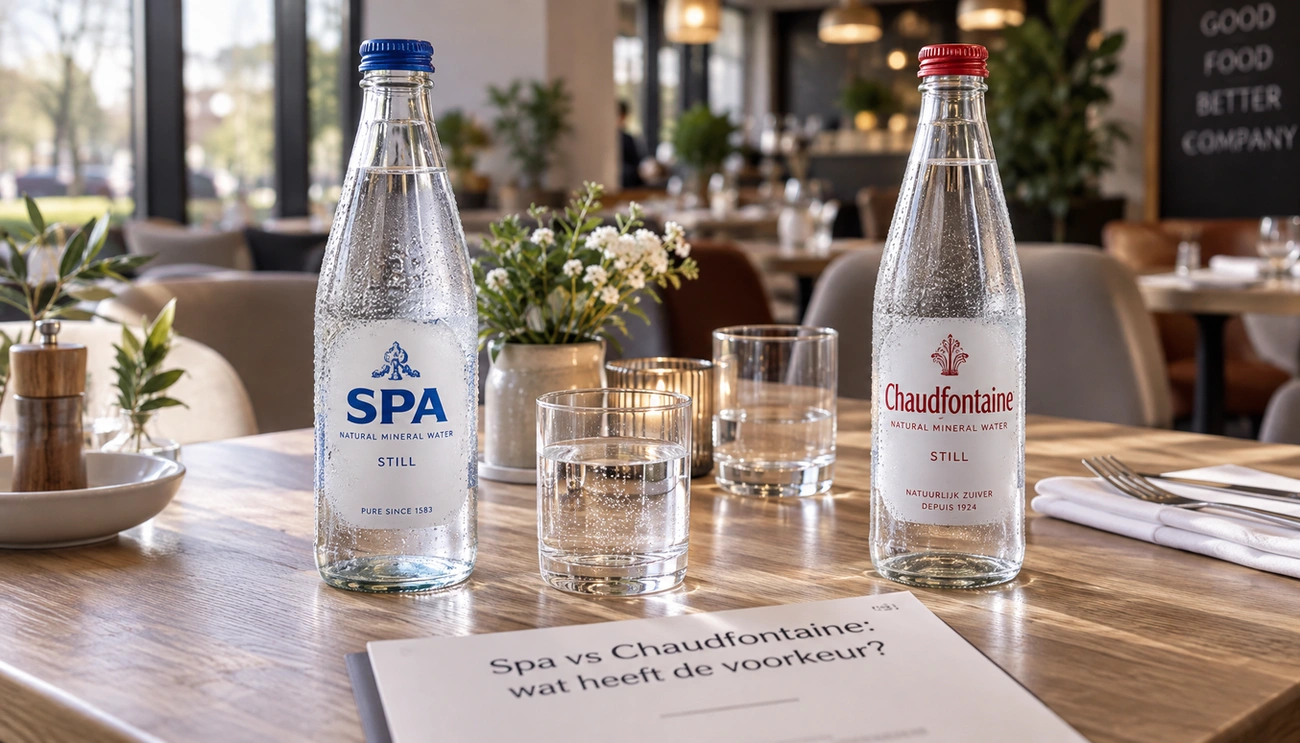
Spa and Chaudfontaine are two water brands that need little introduction in the Benelux. Yet hospitality businesses and retailers face the same question time and again: which brand best suits my product range and my target audience?
The answer is not as simple as it seems. Fourteen to twenty percent of the water products studied exceed the Dutch drinking water standards for sodium, potassium, sulphate and fluoride. Despite this, Chaudfontaine sparkling water and Spa remain market leaders in the Benelux. But the choice between the two brands is about more than just name or popularity.
We cover the key differences in composition, packaging, pricing and applications, so you can make an informed choice that benefits both your margin and your customer satisfaction.
WHAT ARE SPA AND CHAUDFONTAINE?
Both brands are Belgian spring water, but that is where the similarities quickly end. Spa comes from the High Fens near the town of the same name, where rainwater filters through layers of peat and mineral-poor rock. The result is a water with just 38 mg of dry residue per litre, making Spa one of the lowest-mineral waters in Europe. Spa Monopole has been bottling since 1583 and is part of the Spadel group.
Chaudfontaine has an entirely different origin. It is thermal water that travels underground for more than 60 years through pure rock layers. The water penetrates to a depth of 1,600 metres, where it reaches a temperature of 52 to 55 degrees Celsius. When it surfaces, it still measures 37 degrees. This combination of exceptional pressure and heat causes mineral exchange, giving Chaudfontaine a more balanced mineral content than Spa. Coca-Cola Belgium acquired the brand in 2003.
For hospitality and retail, this difference translates directly into how each is used. Spa positions itself as ultra-pure and light, ideal for customers who prefer low-mineral water. Chaudfontaine sparkling water combines thermal purity with added carbonation, which stimulates the appetite at mealtimes. In effect, your target audience already determines which brand fits your range: are you looking for an extremely low mineral content, or a lightly mineralised water with a soft taste?
WHY SPA AND CHAUDFONTAINE REMAIN POPULAR IN 2026
Water consumption is rising steadily among Dutch consumers, which translates directly into stable sales for hospitality and retail. 86 percent of Dutch consumers drink water daily, an average of 4.1 glasses per day. Thirst (68%), hydration (62%) and refreshment (51%) are the main motivations. Water is therefore not an impulse purchase but a fixed item in every range. For you as a buyer, this means predictable demand and reliable revenue.
On top of that, the quality of Spa and Chaudfontaine was confirmed once again in 2026. The NVWA (Netherlands Food and Consumer Product Safety Authority) inspected all 14 companies holding 19 licences for spring and mineral water in the Netherlands. There were no indications of fraud or food safety risks. Both brands fully comply with the Dutch Packaged Waters Decree (Warenwetbesluit Verpakte Waters), guaranteeing consistent quality from source to consumer. This means you can serve your customers with complete peace of mind.
Both producers are also actively investing in sustainability. Spa uses 25% recycled PET and supplies 100% recyclable bottles. The water filters for years through natural layers of earth without additional treatment, making it drinkable straight from the source. This fits seamlessly with the sustainability requirements of modern retailers.
Consumer trust, controlled quality and a sustainable image: that is a combination that works. For wholesalers, this results in predictable revenue with low return rates. You can truly rely on both brands.
HOW BUSINESSES USE SPA AND CHAUDFONTAINE SMARTLY
Hospitality businesses often use both brands in a complementary way. Spa, Sourcy and Chaudfontaine are the best-known names on the 20cl or 25cl hospitality bottle. Spa serves as the light, low-mineral option, while Chaudfontaine sparkling water plays the role of appetite stimulant at mealtimes. Two brands, one water menu, more value for your guests.
What Spadel's figures tell you is interesting. The producer of Spa raised prices following rising raw material and energy costs. Revenue grew by 8 percent to 346 million euros; volume in the Benelux fell, but net profit doubled to more than 28 million euros. For retailers, this means that price optimisation delivers more than volume growth for established water brands. You don't need to sell more; you need to sell smarter.
Competitive pricing remains the most widely used strategy. By setting your prices sharply relative to competitors, you win market share among price-sensitive customers. Competitive intelligence tools help by automatically mapping competitors' pricing strategies, allowing you to adjust in real time.
Inventory planning is the final piece. Smart distributors use inventory as a competitive tool: delivering on time and in full, without unnecessary storage. Service-level-driven demand planning prevents shortages and keeps your revenue up, because customers who can't find a brand will look elsewhere. You can truly rely on us for the availability of both brands.
VARIANTS, PACKAGING AND APPLICATIONS
Spa draws from three separate springs, each with its own character. The Reine spring supplies Spa Reine (blue), still water. The Barisart spring produces Spa Intense (red) with added carbonation. And the Marie-Henriette spring is naturally carbonated and supplies Spa Finesse (turquoise). In addition, Spa Fruit offers several flavours based on Finesse, including Lemon Cactus, Apple and Forest Fruit. Since 2016, Spa has used a combination of stevia and sucrose instead of aspartame. This allows you to offer the right variant for every moment and every preference.
And what about Chaudfontaine? The brand combines lightly mineralised thermal water with added carbonation and offers both still and sparkling variants, complemented by flavour options such as Blackberry & Lime and Fusion Watermelon & Melon. Fresh choices that fit perfectly on a contemporary hospitality menu.
Packaging size also determines how you use both brands. Hospitality venues usually opt for 25cl glass bottles, restaurants go for 75cl bottles, while offices and events buy 33cl to 50cl PET bottles. Spa has also introduced the 5-litre Eco Pack with 65 percent less plastic. So there is a suitable format in your range for every occasion.
The mineral content makes the difference concrete. Spa Blue contains just 33 mg of dry residue per litre, Chaudfontaine 385 mg. For optimal refreshment, serve Chaudfontaine chilled at 8 to 10 degrees Celsius. Your customers will notice the difference immediately.
Common mistakes in purchasing and sales
Good purchasing decisions start with product knowledge. Yet we regularly see hospitality businesses and retailers make the same mistakes with bottled water, resulting in avoidable costs.
Take storage in direct sunlight. This affects the chemical stability of PET bottles, releasing microplastics. German researchers found thousands of particles per litre. The problem lies not only in the bottle itself, but also in the caps and in transport. Both release particles during use and transport. A cool, dark storage area is therefore not a luxury but a necessity.
Blindly trusting brand names without comparing mineral values costs you money. A well-known mineral water contains 65 mg of calcium and 44 mg of sodium per litre. Dutch tap water provides 15 to 80 mg of calcium and usually less than 20 mg of sodium. And consider this: one glass of milk contains more calcium than an entire litre of mineral water. So you can see for yourself that the added value of premium water does not always lie in its mineral composition.
Bulk purchasing without taking packaging shelf life into account leads to unnecessary write-offs. In addition, you often pay for premium water with the same composition as private-label brands. Tap water costs 0.2 euro cents per litre, private-label bottled water 30 to 45 cents, and premium brands around one euro. Someone who drinks one litre a day pays less than one euro per year via the tap. For premium brands, this rises to 365 euros. Tap water is on average 500 times cheaper.
That doesn't mean premium brands like Spa and Chaudfontaine offer no value. But your purchasing decision should be based on facts, not on brand name alone. Always compare mineral values with your purchase price and tailor your range to what your customers actually need.
CONCLUSION
Spa and Chaudfontaine are both strong brands, each with a clear profile of its own. Spa delivers low-mineral water for customers who prefer light and pure. Chaudfontaine sparkling water suits premium hospitality and mealtimes. Both brands meet all quality standards, so your choice ultimately comes down to your target audience and your margin strategy.
Always compare mineral values with your purchase price before deciding. Plan your inventory smartly so you never disappoint your customers. By offering both brands in a complementary way, you create more value for your customers and for your own range.
That makes selling water a lot more interesting again. For you, but above all for your customers.
FREQUENTLY ASKED QUESTIONS (FAQ)
Which water contains fewer minerals, Spa or Chaudfontaine?
Spa Blue contains just 33 mg of dry residue per litre, while Chaudfontaine measures 385 mg. For comparison: Spa Intense has a dry residue of 47 mg/L and Spa Finesse 80 mg/L. Chaudfontaine naturally contains more minerals such as calcium, magnesium and bicarbonates. For daily use, we recommend low-mineral water, as you already get enough salts through your diet.
Is Chaudfontaine suitable for children?
Yes, its gentle mineral composition makes Chaudfontaine suitable for everyone. The water filters naturally for decades through deep rock layers, without additional treatment. You'll notice it immediately in the soft, balanced taste.
Why does Chaudfontaine taste softer than other water brands?
The thermal water reaches a depth of 1,600 metres without fractures or branching. This exceptional filtration produces a balanced, rich taste with no residues of pesticides or nitrates. That is how Chaudfontaine stands out in a way your guests will notice right away.
Which water suits health-conscious guests?
Spa is an excellent choice for health-conscious consumers. It contains no added sugars and supports hydration in a light, non-carbonated way. The range runs from mild Spa Blue to sparkling Spa Red, allowing you to effortlessly cover both daily use and special occasions.
KEY TAKEAWAYS
Spa and Chaudfontaine are both strong brands, each with a clear profile of its own. Spa delivers 33 mg of dry residue per litre for customers looking for low-mineral water. Chaudfontaine offers 385 mg for those who prefer lightly mineralised water. Both brands meet NVWA standards, so you can rely on their quality.
What else you can take away: margin optimisation beats volume growth. Spadel raised prices and doubled its net profit despite a drop in volume in the Benelux. That says it all about how established water brands perform best.
Practical purchasing tips:
86 percent of Dutch consumers drink water every day. That guarantees stable sales, provided you make the right choices. Your target audience and desired margin determine which brand takes the lead. Combine that with smart inventory planning and you boost both customer satisfaction and profitability in one move.
At Frisdrank.com you can always request a free, no-obligation quote for Spa, Chaudfontaine and more. See for yourself what advantages we can offer you. And you're never locked in, because that's how flexible we are.