
A-brands, competitive prices
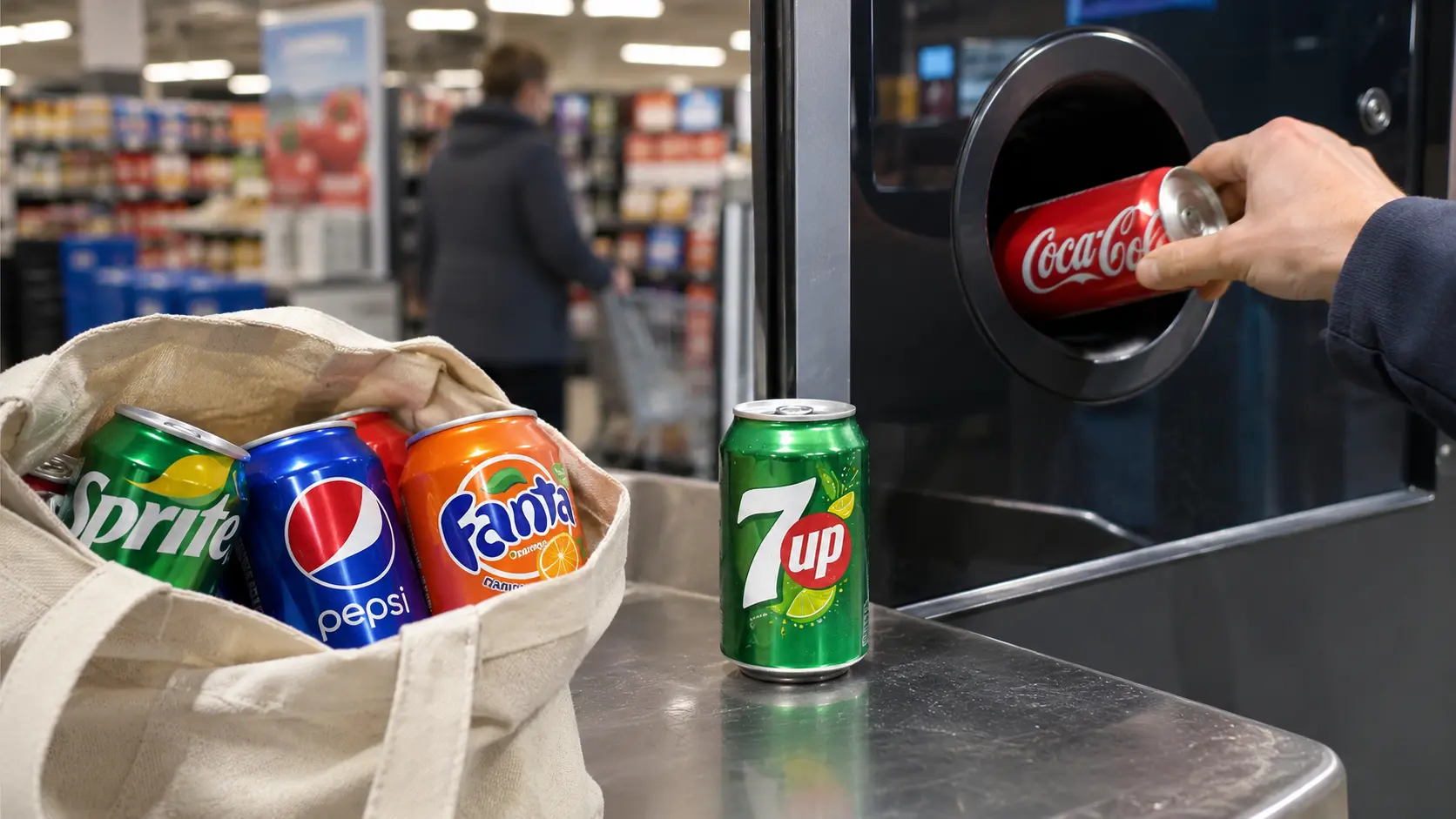
Deposits on cans have quickly changed the way the Netherlands deals with packaging waste. Since the deposit on cans was introduced, millions of containers have disappeared from litter. Even so, the collection rate for plastic bottles is still below the legal target of 90%. In 2024 Verpact reached 77%, a figure that is being adjusted to 83% following a directive from the State Secretary.
For hospitality businesses, retailers and wholesalers, this has real consequences for stock management and for customer convenience at the reverse vending machine. In this article you'll find out how much the deposit on a can is, and how can deposits differ between the Netherlands, Belgium and Germany. You'll also read how trade buyers can respond smartly to these rules.
WHAT IS THE DEPOSIT ON CANS AND WHY DOES IT STILL MATTER IN 2026?
The deposit on cans is set out in law in the Dutch Packaging Management Decree (Besluit beheer verpakkingen). It applies to metal drinks containers of up to 3 litres, both alcoholic and non-alcoholic. That includes beer, soft drinks, water, mixers and juices. You charge a €0.15 deposit per can, whatever its size. Cans of squash, fruit concentrate or condensed milk are not included, and nor are food tins that contain no liquid.
The deposit will stay relevant in 2026 because of specific legal measures. Verpact has not yet met the 90% collection target for plastic bottles, so the Human Environment and Transport Inspectorate (ILT) has issued five orders subject to penalty payments. As a result, Verpact must set up at least 5,400 extra return points that pay out deposits before 1 January 2027. This directly affects the return infrastructure that hospitality and retail have to deal with.
The results so far are clearly measurable. Since the scheme started in April 2023, the number of cans in litter has fallen by 80%, and 91% of Dutch people support the system. More than 6.6 billion cans have now been returned, and 93% of the population return their containers regularly. This puts the Netherlands alongside countries such as Germany, Finland, Norway and Denmark, which have had deposits on cans for longer. For trade buyers, this means can deposits are here to stay and not a temporary measure.
HOW HOSPITALITY AND RETAILERS CAN ORGANISE DEPOSITS SMARTLY
A well-organised return process saves hospitality businesses and retailers time and avoids long queues at the till. Do you sell more than 1,600 deposit cans and bottles a month? Then you qualify for a free reverse vending machine from Statiegeld Nederland. Short on space? A small machine of around 1 square metre is enough for returning containers one at a time.
For larger volumes, a bulk machine makes more sense. Customers can return more than 100 containers at once without feeding them into the reverse vending machine one by one. Makro showed the benefit of this by installing bulk machines at 16 stores, so hospitality customers are done in 10 to 15 minutes rather than much longer. Deposits are paid out there via Tikkie, except in Vianen, where they're refunded to a debit card.
Supermarkets larger than 200 square metres and staffed motorway service stations are legally required to accept deposit containers and pay out the deposit. Smaller sites can sign up voluntarily and then receive free servicing and maintenance and a monthly allowance for costs. That's how retailers and wholesalers can handle can deposits efficiently, without investing in extra staff or space.
WHAT HAPPENS AFTER A CAN IS RETURNED? RECYCLING AND FREQUENTLY ASKED QUESTIONS
Once returned, every can follows a set route to a new life. The full bags go to a counting centre, for example in Utrecht or Tilburg, where everything is counted, sorted and compressed into bales. These bales then travel on to the recycling centre in Neuss, just over the German border, where a shredder and an X-ray scanner separate the aluminium from other material. The coating is then burnt off at 500°C, the aluminium is melted at 730°C and rolled into thin strips for new cans. The can is back on the shelf within sixty days.
The recycling rate for aluminium packaging rose from 69% in 2023 to 84% in 2024, although the legal collection target of 90% for cans is still out of reach.
Frequently asked questions are often about which containers the reverse vending machine will accept. A container is accepted if:
Machine still refusing it? Ask a member of staff at the service desk for help. Interestingly, Belgians sometimes cross the border to claim the Dutch deposit on containers carrying the correct logo.
CONCLUSION
Can deposits are now a permanent part of running your business, not a temporary obligation. With the right return solution, such as a reverse vending machine or a bulk machine, you save time and avoid queues at the till. A clear understanding of the rules and the recycling process also means fewer surprises during inspections. That way, as a hospitality business, retailer or wholesaler, you'll be ready for the tightening targets in the run-up to 2027, with happy customers and efficient stock management.