
A-brands, competitive prices
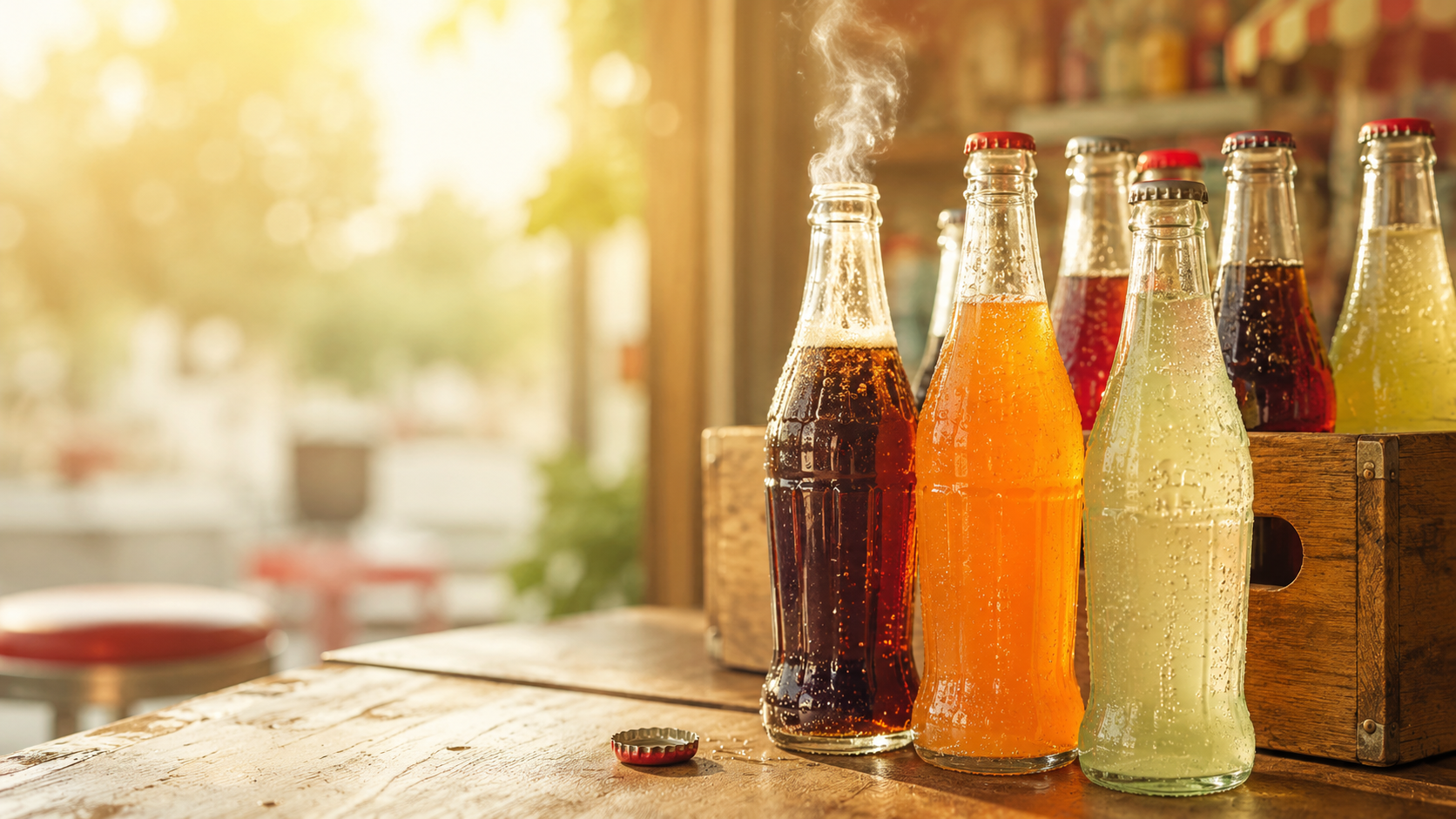
Glass-bottled soft drinks generate an average of 12.8% more revenue for hospitality businesses compared to establishments that only offer other types of packaging. That's no coincidence. Glass retains carbonation considerably better than plastic, because the material remains almost completely sealed off from the outside world. The taste stays exactly as it was intended.
The popularity of glass cola bottles is also historically rooted. Small glass bottles with caps, such as the historic Coca-Cola king size bottle of 29.6 cl, already accounted for 14.6% of total Dutch sales back in 1963. For retailers and hospitality businesses, the glass bottle has therefore long ceased to be a novelty — it's a proven strategic choice.
What makes glass bottles still so appealing in 2026? And how do you use them smartly to increase margins with your target audience? You'll find out in this article.
WHAT ARE SOFT DRINKS FROM GLASS BOTTLES?
Small glass bottles with caps have been the standard packaging for soft drinks in Dutch hospitality and retail for decades. It all started with the introduction of the iconic Coca-Cola contour bottle in 1916. The design had to be so distinctive that it would remain recognizable by touch — and even in pieces on the floor. That's how the glass bottle became an icon that retains its value to this day.
An important practical advantage is reusability. Each bottle lasts an average of 25 to 30 uses before being melted down and blown anew. This makes glass cola bottles not only sustainable but also cost-efficient within the circular loop. The standard size for hospitality is 20 cl, but 33 cl variants are also available for guests with a bigger thirst.
Plastic bottles are slightly permeable, which means small amounts of carbon dioxide escape over time. Glass prevents that. Still, there is one nuance we don't want to withhold from you. French research showed that glass bottles contain an average of 100 plastic particles per liter — 5 to 50 times more than plastic bottles or cans. The source turned out not to be the glass itself, but the paint on metal crown caps. Tiny scratches caused by friction during storage release paint particles into the drink.
For day-to-day hospitality operations, this changes little about the convenience. You hand a glass bottle straight to the table without pouring, whereas large bottles require extra steps such as ice and garnish. That's how the glass bottle works in your favor, both behind the bar and at the table.
WHY SOFT DRINKS FROM GLASS BOTTLES REMAIN POPULAR IN 2026
The deposit return system plays a major role in this. Since April 2023, 93% of all Dutch consumers have been returning glass bottles to collection points. More than 6.8 billion bottles have been returned since June 2021. For hospitality and retail, this means a reliable supply loop without dependence on new production.
Glass can be recycled endlessly without any loss of quality, with new bottles already consisting of 50 to 80 percent recycled cullet. On top of that, SUP legislation now prohibits single-use plastic packaging in many hospitality situations. Glass alternatives are therefore no longer a choice but an obligation. Brands such as Coca-Cola Zero and Fanta Orange respond cleverly to this by explicitly positioning their 20 cl hospitality bottles as premium products.
Taste plays a role as well. Food chemists confirm that glass, as an inert material, causes no flavor change whatsoever. Plastic releases acetaldehyde, and aluminum cans contain polymers that absorb small amounts of flavor. Moreover, glass contains no BPA or other chemicals that can leach into drinks from plastic. Your guests can taste the difference.
And what about the effect on your margin? Hospitality operators report that the premium look of glass bottles persuades customers to opt for more expensive drink options. In this way, the glass bottle delivers direct margin increases without requiring any extra effort on your part.
HOW RETAILERS AND HOSPITALITY BUSINESSES USE GLASS BOTTLES SMARTLY
Small glass bottles give your service staff a head start. You serve them directly at the table without pouring, while large bottles require extra steps such as ice, garnish, and the pouring itself. That saves time behind the bar and ensures a consistent presentation for every guest. It's practical even for the youngest visitors: children can easily drink from a bottle with a straw without spilling.
Industry associations aim for half of all drinks to be served from glass bottles within a short time frame. Some guidelines go even further, stating that three quarters of drinks should come from small hospitality bottles. For your profit margin, calculate 8 to 10 servings per bottle to cover costs.
Glass bottles also offer room to tell your own brand story. You can personalize them with embossing or engraving. There are also modern decoration options such as sleeves, special glaze effects, glossy colors, or gold and silver coating. And what about 3D labels that immediately catch customers' attention and strengthen your premium positioning?
Artisanal soft drinks with natural ingredients also differentiate your location from the standard assortment. Miniature bottles of 10 to 100 ml work excellently as samples, corporate gifts, or luxury presentations in delicatessens. For to-go concepts, choose stackable formats that are transport-friendly and can withstand hot filling. This way, you create the right offering for every situation and give your customers a reason to keep coming back.
VARIANTS, PACKAGING, AND APPLICATIONS OF GLASS BOTTLES
Hospitality operators typically order crates of 24 glass bottles of 20 cl. For guests with a bigger thirst, 33 cl variants are also available. And what about miniature bottles of 2 cl to 5 cl? These formats serve as collectibles, corporate gifts, and samples for discovering new flavors. That way, you can organize successful tastings without large inventory investments.
Each glass bottle is sealed with a crown cap containing exactly 21 teeth. This specific configuration originated in 1891, when inventor William Painter discovered that 20 or 22 notches provided insufficient sealing. The teeth grip firmly around the bottle neck and keep the carbon dioxide under pressure, preserving the bubbles for months. Modern crown caps contain a plastic sealing layer instead of the original cork.
Coca-Cola recently introduced a 1L bottle that weighs 140 grams less, meaning a crate of 6 bottles weighs 840 grams less. This reduces transport costs without compromising reusability. That consumers appreciate this is also evident from the figures: 53% of Belgians choose water or soft drinks in glass at least occasionally, citing better taste and better-preserved fizz as the main reasons. Time and again, glass proves its value — both for you and for your customer.
COMMON MISTAKES WHEN BUYING AND SELLING GLASS BOTTLES
Ordering too much stock remains the biggest purchasing mistake with glass bottles. Overstuffed storage rooms drive up your food cost unnecessarily, increase the risk of theft going unnoticed, and undermine your FIFO discipline. Products exceed their best-before dates, and you're then forced to offer discounts to free up space. That puts direct pressure on your margins.
A detailed order form prevents costly misunderstandings. Without clear specifications, such as the number of units per packaging unit, you may pay for 24 bottles while only 12 are delivered. It also allows you to verify that you actually receive the quality you ordered instead of a cheaper variant.
Many entrepreneurs focus exclusively on the lowest price, but that isn't always the smartest choice. Cheap glass bottles show inconsistent dimensions, weaker glass, or poor sealing. Reliable quality significantly reduces breakage and product waste. Moreover, it's not the volume but the neck size with its thread profile that determines which cap fits. A cap that seems to roughly fit but whose liner doesn't properly touch the bottle rim will screw on crooked and seal less securely.
Deposit-return glass bottles also require storage space for empty crates, hygienic management against sticky residues, and regular time for returns. You can truly count on us for practical advice on all of this.
CONCLUSION
For your hospitality business or shop, glass bottles are more than just a packaging choice. The better carbonation retention, the premium appearance, and the reliable deposit return system together create an offering that makes your customers happy and leaves you with an attractive margin.
Choose a well-considered assortment of 20 cl and 33 cl variants, maintain FIFO discipline to avoid overstock, and always choose reliable quality over the lowest price. Cheap often turns out to be expensive in practice, especially when it comes to breakage and poor sealing.
We at [company name] are happy to help you put together the right assortment of glass bottles for your target audience. You can always request a free, no-obligation quote from us. That way, you can see for yourself what advantage we can offer you. You decide who you do business with, but we're confident we can make you the best offer. You can truly count on us.