
A-brands, competitive prices
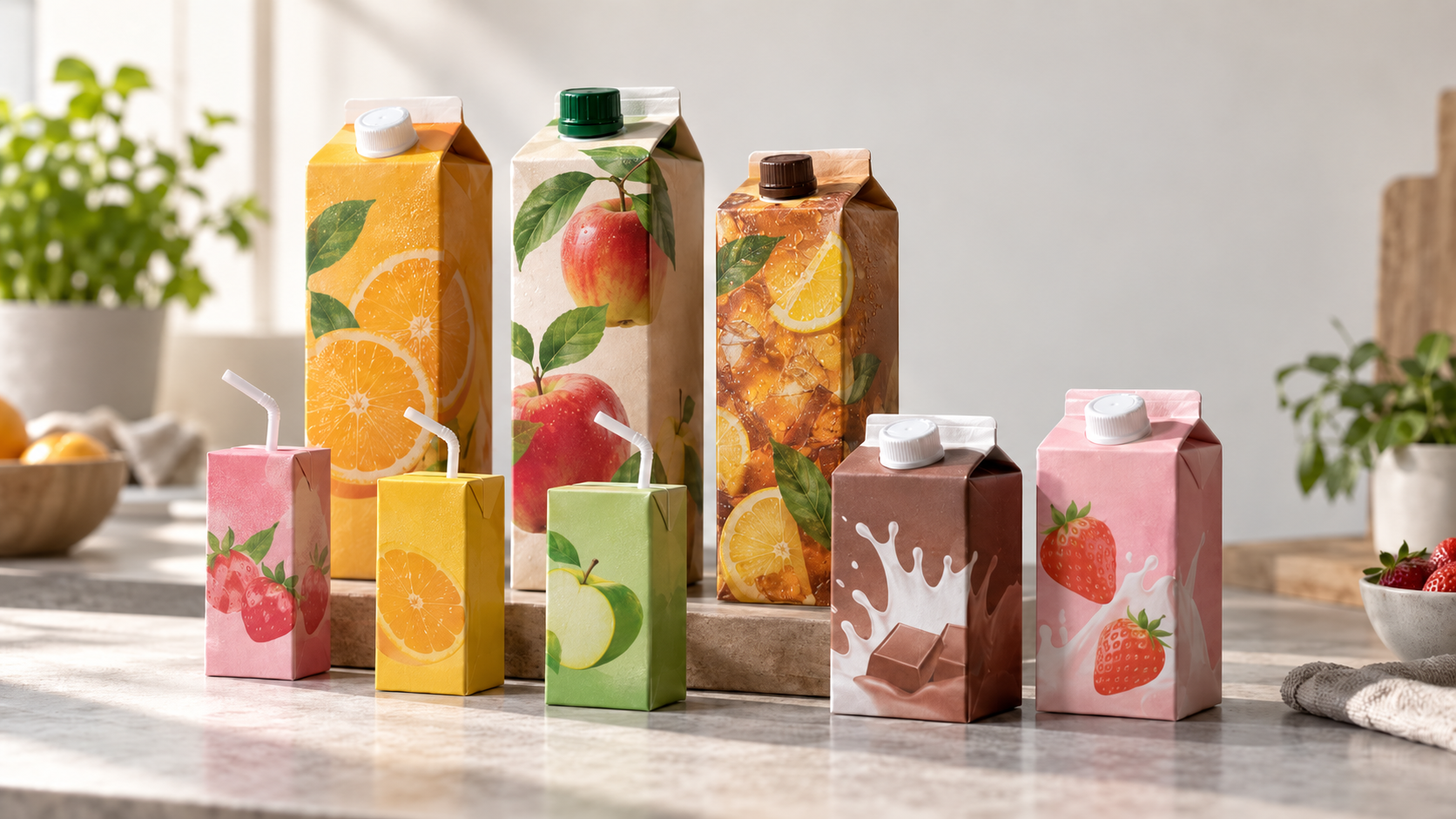
More than half of the drinks sold in small cartons contain hardly any fruit: 58% consist of just one-fifth fruit juice or less. Consumers are increasingly seeing through this. As a hospitality or retail business owner, you notice it immediately in the questions customers ask and the choices they make.
Beverage cartons are under pressure. Environmental concerns, the limited recyclability of multilayer packaging, and a growing demand for transparency are casting this product category in a different light. On top of that, nearly 33 kilos of food per Dutch resident ends up in the bin every year. That awareness only strengthens the focus on sustainable alternatives.
What does this mean for your product range? We explain why traditional drink cartons no longer meet today's business requirements, which modern alternatives are available, and how you as an entrepreneur can respond.
WHAT ARE DRINKS IN CARDBOARD CARTONS?
Drink cartons, also known as beverage cartons, consist of multilayer packaging made of paper, aluminium, and plastic. This combination protects the contents and significantly extends shelf life. Tetra Pak developed this form of packaging in 1951 and grew into the global market leader, delivering no fewer than 193 billion packages in 2022.
These cartons appear across various product categories in your assortment. Think of milk, yoghurt, custard, fruit juices, soup, and sauce. Especially for small portions and to-go concepts, this packaging has become a familiar part of the beverage offering for hospitality and retail.
Tetra Pak was originally founded by Ruben Rausing and Erik Wallenberg. The name derives from their first product: a cardboard drink package shaped like a tetrahedron. The Swedish company is now active in more than 160 countries and generates revenue in equal parts across Asia, North and South America, and Europe.
The recycling process for these cartons requires separating the different materials. Sorting facilities pull drink cartons out of the waste stream, after which specialised companies separate the paper, film, and aluminium to turn them into new raw materials. This ultimately produces items such as pens, boxes, and newsprint. Sounds airtight, but in practice it's more stubborn than it seems.
WHY DRINK CARTONS WERE POPULAR IN THE PAST
Convenience was central to the popularity of cardboard cartons for years. For parents, they meant a quick solution: ready to use, easy to take along, and no extra cup needed. Supermarkets prominently presented this packaging as the ideal choice for the school bag or day trips. Marketing did the rest. Advertising and promotions talked consumers into these convenience cartons, even though for many they were actually unnecessary.
For hospitality and retail, there was clear business logic. Drink cartons required no refrigeration during transport, had a long shelf life, and were easy to stack. This allowed wholesalers to deliver large volumes without complicated logistics. The standardised packaging also created recognition among customers and reliable revenue for retailers.
Schools and daycare centres adopted these cartons en masse. No hassle with rinsing, no breakable glass bottles, and portion control guaranteed. On the playground, the drink carton quickly became a given.
The combination of ease of use, marketing pressure, and practical applications drove strong demand for decades. Retailers benefited from consistent margins and a reliable product group. But the market is changing. What worked for years is now under pressure.
PROBLEMS WITH CARDBOARD CARTONS IN 2026
In practice, the recyclability of cardboard cartons falls well short. A drink carton consists of roughly 75% cardboard, 20% plastic, and 5% aluminium. Separating those materials requires specialised installations using water and friction. The Netherlands currently achieves only 60% collection, while Belgium realises more than 90% thanks to separate targets. That difference says enough.
And the actual recycling rate is even lower. Of the material collected, around 30% is effectively recycled, with mainly the cardboard being recovered. The plastic and aluminium usually end up in incinerators or landfills. Laminates make up 20% of all flexible packaging and are difficult to separate because the materials are bonded together. So the promised sustainability of drink cartons largely remains on paper.
And what about the plastic coating on the inside? BPA in that inner layer functions as an endocrine disruptor and has been linked to reproductive disorders, cancer, and obesity. BPA-free alternatives use similar substances such as BPS, which exhibit the same hormonal activity. For your customers, this is a concern that comes up more and more often.
For your business, this means increased pressure from the market. Consumers demand transparency about recycling and health, and you notice that directly in your offering. Cardboard cartons no longer meet these business requirements in 2026. Fortunately, more and more alternatives are becoming available that do align with what your customers expect.
MODERN ALTERNATIVES TO DRINK CARTONS
Fortunately, good alternatives are ready and waiting. Glass bottles are fully recyclable without loss of quality when reused. Glass contains no BPA or other chemicals that can leach into drinks, and it preserves the natural taste. Modern glass bottles made of borosilicate glass are resistant to knocks and temperature fluctuations. This way, you offer your customers a premium alternative that stands out on the shelf and strengthens your brand positioning.
Reusable cups are a practical alternative for hospitality and office environments. These polypropylene cups are BPA-free, dishwasher-safe, and tested for a minimum of 250 to 1,000 wash cycles. They comply with SUP legislation and are fully recyclable. For your business, this means lower operational costs through reuse and less waste processing.
And what about stainless steel drinking bottles? These keep drinks warm for up to 12 hours and cold for up to 24 hours. Context matters here, though: double-walled stainless steel sometimes requires decades of use to catch up with the environmental footprint of reusable plastic bottles. The average Dutch person opens 7 packages a day, and 20 percent of our waste consists of packaging. Every alternative you choose helps reduce that waste stream directly. Your customers notice it, and so does your bottom line.
HOW RETAILERS AND HOSPITALITY BUSINESSES ARE ADAPTING
The market is moving. Major supermarkets are taking the lead, and that's a clear signal. PLUS made all fresh dairy, unprocessed onions, and potatoes under its own brand organic as standard. Jumbo sells all pre-cut vegetables in its produce section with the On the Way to Planet Proof certification. In this way, these retailers actively steer consumers towards more sustainable choices, including through prominent placement of produce sections and lower prices for meat substitutes.
Caterers are setting ambitious goals too. Albron aims for 60% plant-based versus 40% animal-based food and wants all new locations to operate CO₂-neutral from 2025 onwards. Eurest promotes healthier choices through nudging and works with local suppliers for shorter supply chains. Bidfood uses its Sustainability Compass to give customers direct insight into the CO₂ emissions of products.
For hospitality, dispensing systems offer a concrete and sustainable alternative. These systems prepare soft drinks on the spot using a water connection and syrup in bag-in-box packaging. That delivers 40% energy savings compared to refrigerated display units. Restaurants can also introduce reusable cups and token systems. This makes sustainability operationally attractive as well.
The government is extending the deposit scheme to all plastic bottles up to 3 litres by January 2028, including dairy and juices. Consumers spend more on products in sustainable packaging, and 65% consider it important whether packaging is recycled. As a business owner, you can respond to this directly with your assortment.
COMMON MISTAKES DURING THE TRANSITION
Many entrepreneurs make the same mistake when switching to sustainable packaging. Bioplastics such as PLA seem a logical step, but under SUP legislation they still fall into the same category as regular plastic. For on-site consumption, these materials are just as prohibited as traditional plastics. Only for takeaway or delivery with proper waste processing can bioplastics be permitted. So you end up paying more for an alternative that makes little difference legally.
And what about compostable packaging? It sounds good, but most municipalities do not collect compostable cardboard cartons separately via organic waste. They end up with residual waste and are incinerated anyway. Compostable alternatives only work with the right infrastructure and clear communication to your customers. Without those two ingredients, the benefit evaporates entirely.
In addition, buyers regularly rely on appearance rather than material. Brown kraft or cardboard cups look sustainable, but often contain a PE coating, PLA coating, or bioplastic lining. In this way, businesses replace plastic packaging with alternatives that look more sustainable but aren't.
Finally, you might think sustainable always ends up costing more. That doesn't have to be the case. The final price depends on material, purchase volume, and application. Calculate costs per order instead of per box. That gives you a fairer picture of what a switch really costs.
CONCLUSION
Cardboard cartons no longer align with what customers expect from you in 2026. Limited recyclability and a growing demand for transparency make that clear. Glass bottles, reusable cups, and dispensing systems are directly applicable alternatives that reduce your waste stream and give your customers a reason to keep coming back.
Always check the material behind the packaging. Brown kraft or a compostable label doesn't tell the whole story. Calculate costs per order instead of per box. That gives you a fairer picture of what a switch really delivers.
Ultimately, the direction you take is up to you. But we're certain that the right choice of sustainable alternatives will benefit both your brand positioning and your operational efficiency. And your customers will notice it immediately.